Book Appointment Now

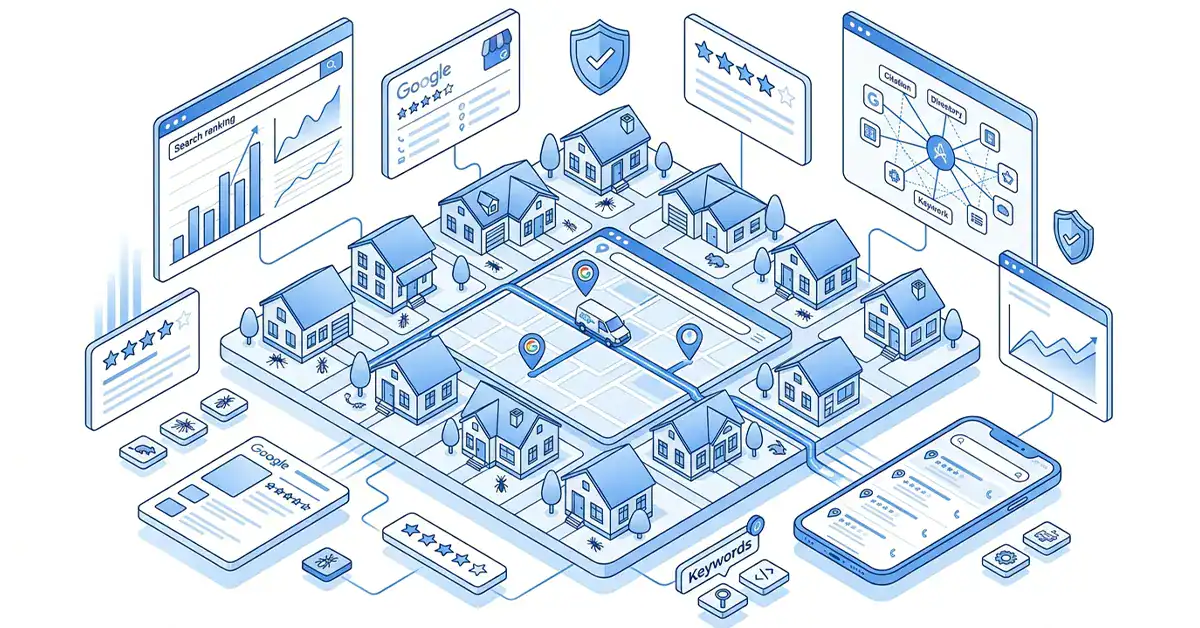
Local SEO Services for Pest Control Companies: The Complete Guide

TL;DR
- Local SEO is how pest control companies win the “near me” moment — the Google Maps 3-pack, the local organic results, and increasingly, AI answer engines like Google AI Overviews and Perplexity.
- Google ranks local results on three pillars: Relevance, Distance, and Prominence — and for pest control specifically, review signals and Google Business Profile (GBP) completeness carry outsized weight.
- A complete, well-categorized Google Business Profile is the single most controllable local ranking asset a pest control company has.
- Reviews aren’t just reputation management — they’re a direct ranking factor. Recency and response rate matter as much as star rating.
- Service Area Businesses (most pest control companies) should hide their street address in GBP and instead lean on service-area pages, citations, and behavioral signals.
- Local landing pages for each city or neighborhood you service, backed by real, unique content (not templated copy), consistently outperform a single generic “service area” page.
- NAP consistency (Name, Address, Phone) across directories, and structured data (LocalBusiness schema), still matter for on-page and citation signals.
- Local SEO for pest control is a compounding asset: unlike pay-per-click ads, the visibility you build keeps working after you stop actively paying for a campaign.
Introduction
If you run a pest control company, your business lives and dies by geography. You can’t treat a termite infestation two states away, and a homeowner searching for “exterminator near me” at 11 p.m. because they just found roaches under the sink isn’t going to scroll to page two of Google. They’re going to call one of the two or three businesses that show up first — on the map, in the local pack, or in an AI-generated summary of “best pest control near me.”
That’s what local SEO services for pest control companies are built to solve. Done well, local SEO puts your business in front of the people who are already looking for exactly what you offer, in the exact area you serve, at the exact moment they’re ready to book. Done poorly (or not at all), you’re relying entirely on paid ads, word of mouth, and whatever leads slip through the cracks of directories you don’t control.
This guide walks through what local SEO actually means for pest control businesses, how Google’s local ranking system works, the specific tactics that move the needle, the mistakes that quietly sink otherwise good campaigns, and how to think about hiring an agency versus doing it in-house. By the end, you’ll have a clear, practical framework for building — or evaluating — a local SEO strategy for your pest control business.
What Is Local SEO for Pest Control Companies?
Local SEO is the practice of optimizing your online presence so your business shows up in location-based searches — think Google Maps results, the “local pack” (the block of three map listings that appears above organic results), and standard organic listings when someone searches with local intent, like “pest control in [city]” or “ant exterminator near me.”
For pest control specifically, this matters more than it does for many other industries because:
- The service is inherently location-bound. You serve a radius around your office or technicians, not the whole internet.
- Demand is often urgent. Bed bugs, wasp nests, and rodent infestations don’t wait, so searchers convert quickly once they find a credible, nearby option.
- Demand is seasonal. Ant and mosquito searches spike in spring and summer; rodent-proofing searches spike in fall; termite inspection searches often follow local swarm seasons.
- Trust is a prerequisite. People are inviting a technician into their home, so reviews, licensing information, and a professional web presence carry real weight in the decision.
Why Local SEO Matters for Pest Control Businesses
The search behavior is overwhelmingly local and mobile
A large share of all Google searches carry local intent, and “near me” style searches have grown dramatically over the past several years as smartphone use has become the default way people look for services. For a pest control company, this means the majority of your best prospects are searching from their phone, from their house, wanting a nearby, trustworthy option — right now.
Most searchers never leave page one
The overwhelming majority of users pick a business from the first page of results. If your pest control company isn’t appearing in the local pack or near the top of organic results for your core service areas, you are largely invisible to a huge share of potential customers, regardless of how good your actual service is.
It’s a durable, compounding channel
Pay-per-click ads for pest control keywords are some of the most expensive in local services marketing, because the intent behind those searches is so high. Local SEO doesn’t replace paid ads, but it builds an asset — rankings, reviews, citations, content — that keeps generating calls and bookings without a per-click cost, and that value tends to compound over months and years rather than disappearing the day you pause a campaign.
Reviews and reputation drive the decision
Because pest control involves letting a stranger into your home, prospective customers lean heavily on reviews and reputation signals before they call. Local SEO and reputation management are deeply intertwined for this industry — a business with a steady stream of recent, positive reviews will consistently out-rank and out-convert a competitor with a stale or thin review profile.
How Google’s Local Ranking System Actually Works
Google has publicly confirmed that local rankings are based on three core factors:
- Relevance — how well your business profile and website match what the searcher is looking for.
- Distance — how close your business (or your service area) is to the searcher.
- Prominence — how well-known and well-regarded your business is, both online and offline.
Industry research groups such as Whitespark run a recurring survey of local SEO practitioners to estimate how much weight different signal categories carry within those three pillars. While the exact percentages shift from year to year and no one outside Google knows the precise algorithm, the surveys consistently point to the same broad pattern:
| Signal Category | What It Includes | Relative Weight (Approximate) |
|---|---|---|
| Google Business Profile signals | Primary/secondary categories, business title keywords, completeness, attributes | Highest single category |
| Review signals | Review quantity, velocity, recency, keyword content, owner responses | Second-highest, and rising |
| On-page signals | LocalBusiness schema, NAP on page, city-specific content, title tags | Significant and fully controllable |
| Link and citation signals | Local backlinks, directory citations, NAP consistency | Moderate but still meaningful |
| Behavioral signals | Click-through rate, calls, direction requests, dwell time | Smaller but growing in importance |
Important nuance for Service Area Businesses (SABs): Most pest control companies operate as SABs — they travel to the customer rather than the customer visiting a storefront. For SABs, proximity is calculated differently, and Google’s own guidance recommends hiding your exact street address on your GBP listing and instead defining a clear service area. This shifts even more of the ranking equation onto relevance and prominence signals, which is exactly where a deliberate local SEO strategy pays off.
Core Components of a Local SEO Strategy for Pest Control Companies
1. Google Business Profile Optimization
Your Google Business Profile (GBP) is the closest thing to a free storefront on Google Maps, and for local pack visibility, it is the single most important asset you control. A strong GBP setup includes:
- Accurate primary category (e.g., “Pest Control Service”) and relevant secondary categories (e.g., “Exterminator,” “Bird Control Service,” if applicable).
- A complete business description that naturally includes your core services and service areas — no keyword stuffing.
- Services listed individually — general pest control, termite inspection, rodent exclusion, mosquito treatment, bed bug remediation, wildlife removal, commercial pest management, etc.
- Accurate hours, including emergency or same-day availability if you offer it.
- Service area defined clearly, with your street address hidden if you’re a true SAB.
- Photos and videos of technicians, vehicles, uniforms, and before/after treatment areas (where appropriate and without violating customer privacy).
- Regular Google Posts — while controlled studies suggest posts alone don’t directly move rankings, they do improve click-through rate and give searchers a reason to trust and choose you.
- Q&A section monitored and seeded with real, useful questions (service guarantees, treatment safety around kids and pets, response times).
2. Review Generation and Management
Reviews function as both a trust signal for humans and a ranking signal for Google. A strong review strategy includes:
- A consistent, ongoing ask — build review requests into your standard post-service workflow (text or email after every completed job) rather than a one-time push.
- Review recency — a business with fresh reviews from the last few months signals to Google (and to searchers) that it’s active and reliable; many searchers specifically filter for or scan recent reviews before choosing a provider.
- Review velocity over review spikes — a steady trickle of new reviews looks more natural and sustainable than a burst of 50 reviews in one week followed by silence.
- Responding to reviews — both positive and negative, with specific, non-templated responses. Generic copy-paste replies are easy for both customers and search systems to recognize as low-effort.
- Diversifying platforms — Google is primary, but reviews on Yelp, Better Business Bureau, Angi, Facebook, and industry-specific directories reinforce prominence signals and give you more surface area to be found.
3. On-Page and Local Content Strategy
Your website needs to do more than list “we serve the tri-county area.” Effective on-page local SEO for pest control includes:
- Dedicated city or neighborhood pages for each distinct area you serve, each with genuinely unique content — local landmarks, service specifics, and locally relevant pest concerns (e.g., a coastal-area page might emphasize termite and moisture-related pests; a suburban page might emphasize seasonal ant and wasp issues).
- Service-specific pages for each core offering (termite control, mosquito treatment, rodent exclusion, bed bug treatment, commercial pest management) rather than one page trying to cover everything.
- LocalBusiness and Service schema markup so search engines can clearly parse your business name, address (if applicable), phone number, service area, and reviews.
- NAP consistency — your Name, Address, and Phone number should match exactly across your website, GBP, and every directory listing. Even small inconsistencies (a suite number here, an abbreviation there) can dilute trust signals.
- Mobile-first design and fast load times, since the majority of “near me” and emergency pest searches happen on a phone.
- Clear calls to action — click-to-call buttons, visible phone numbers, and simple booking or quote-request forms.
4. Local Citations and Directory Listings
Citations — mentions of your business name, address, and phone number on other websites — reinforce prominence and trust. Priority citation sources for pest control companies typically include:
- General directories: Google Business Profile, Bing Places, Apple Business Connect, Yelp.
- Industry-specific directories: pest control association directories, home-service marketplaces (Angi, Thumbtack, HomeAdvisor), and Better Business Bureau.
- Local directories: chamber of commerce listings, local news or community sites, and regional business associations.
The goal isn’t volume for its own sake — it’s consistency. A handful of accurate, well-maintained citations on relevant, reputable sites will outperform dozens of citations on low-quality or irrelevant directories.
5. Backlinks and Local Authority Building
Links from other local or industry-relevant websites strengthen prominence. Realistic, sustainable approaches for pest control companies include:
- Sponsoring local community events, youth sports teams, or charity drives (many will link back to your site).
- Partnering with local real estate agents, property managers, or home inspection companies for referral relationships and mentions.
- Getting featured in local news coverage of pest issues (seasonal tick warnings, invasive species alerts) by acting as a source for local journalists.
- Contributing guest content to home-service or local lifestyle blogs.
6. Local Service Ads and the Paid/Organic Relationship
Google Local Service Ads (LSAs) appear above traditional ads and organic results for many home-service categories, including pest control in supported markets. LSAs run on a pay-per-lead model and are heavily influenced by review count, review rating, responsiveness, and Google Guarantee/screening status. Many successful pest control marketing programs treat LSAs and organic local SEO as complementary rather than competing: LSAs capture immediate, high-intent leads, while organic and GBP work builds the long-term visibility and trust that keeps costs down over time.
Step-by-Step: Building a Local SEO Foundation
- Audit your current presence. Check your GBP completeness, search your business name plus “reviews,” and check your NAP consistency across major directories.
- Claim and fully complete your Google Business Profile, including categories, services, service area, hours, and photos.
- Fix NAP inconsistencies across your website, GBP, and existing directory listings.
- Build out city/service pages with genuinely unique, useful content — not duplicated text with the city name swapped.
- Implement schema markup for your business and each service.
- Launch a systematic review request process tied to every completed job.
- Identify and claim priority citation sources relevant to your industry and region.
- Track rankings, calls, direction requests, and website clicks monthly, and adjust based on what’s actually driving booked jobs — not just impressions.
- Layer in local link-building and community engagement once the foundation is solid.
- Revisit seasonally — refresh content and GBP posts around seasonal pest cycles (ants and mosquitoes in spring/summer, rodents in fall, termite swarm season in your region).
Benefits of Local SEO for Pest Control Companies
- Lower cost per lead over time compared to paid advertising alone.
- Higher-intent traffic — people searching “termite inspection near me” are further along in the buying decision than someone seeing a generic ad.
- Increased trust and credibility from strong reviews and a complete, professional online presence.
- Better visibility across multiple surfaces — Google Search, Google Maps, Apple Maps, and increasingly AI-generated answers that pull from the same underlying business data.
- A compounding marketing asset that continues generating leads even during periods of reduced ad spend.
Common Mistakes Pest Control Companies Make with Local SEO
- Listing a street address on GBP when operating as a Service Area Business, which can create confusion and may not align with Google’s guidance for SABs.
- Duplicating city-page content by simply swapping the city name into an otherwise identical template — this rarely ranks well and can look thin or manipulative to search engines.
- Ignoring reviews after initial setup — no consistent ask process, no responses, and long gaps between new reviews.
- Keyword-stuffing the business name field in GBP (e.g., adding “Best Pest Control Springfield Exterminator” to the official business name), which violates Google’s guidelines and risks profile suspension.
- Inconsistent NAP data across the website, GBP, and directories, which dilutes trust signals.
- Treating local SEO as a one-time project rather than an ongoing program that needs regular content updates, review requests, and monitoring.
- Over-relying on paid ads without building the organic and GBP foundation that keeps long-term acquisition costs sustainable.
- Neglecting mobile experience — slow load times or hard-to-find phone numbers cost conversions even when rankings are strong.
Expert Tips for Pest Control Local SEO
- Prioritize your Google Business Profile above almost everything else. It is the most heavily weighted and most controllable local ranking asset you have.
- Treat reviews as an operational process, not a marketing afterthought. Build the ask into your technician’s workflow and your post-job follow-up communications.
- Write for the specific pest concerns of each area you serve, not just the city name. Genuine local relevance (climate, common regional pests, seasonal patterns) reads as authentic to both users and search engines.
- Respond to every review individually, especially negative ones — a thoughtful, specific response to a critical review often does more for trust than another five-star review.
- Keep your NAP data identical everywhere, down to formatting (suite numbers, abbreviations, phone number format).
- Don’t abandon local SEO once you rank. Rankings that are neglected erode as competitors keep building their own signals.
Local SEO Services: What to Look for in an Agency
If you’re evaluating outside help rather than managing this in-house, look for:
- Pest control or home-services specialization, or at minimum, a demonstrated track record with service-area businesses.
- Transparency about tactics — an agency should be able to explain exactly what it’s doing on your GBP, your website, and your citations, not just report vague “rankings improved” summaries.
- A clear reporting process tied to calls, direction requests, form submissions, and booked jobs — not just keyword position screenshots.
- No guarantees of specific rankings. No legitimate agency can guarantee a #1 Google ranking, because Google’s algorithm isn’t public and changes constantly. Be cautious of anyone who promises it.
- A review generation process, since reviews are such a central ranking and conversion factor for this industry.
Conclusion
Local SEO for pest control companies isn’t a single tactic — it’s a coordinated system of Google Business Profile management, review generation, locally specific website content, consistent citations, and steady authority-building, all aimed at the same outcome: being the business that shows up, looks trustworthy, and gets the call when someone nearby has a pest problem right now.
The businesses that win the local pack consistently aren’t the ones chasing algorithm hacks — they’re the ones with complete profiles, real reviews arriving steadily, genuinely useful local content, and consistent business information across the web. That combination compounds over time, which is exactly what makes local SEO one of the more durable investments a pest control company can make in its growth.
If you’re ready to build or strengthen your local SEO presence, start with a full audit of your Google Business Profile and your review process — those two areas alone typically account for the majority of local ranking weight, and they’re both fully within your control.
Frequently Asked Questions
1. How long does local SEO take to show results for a pest control company? Most businesses start seeing measurable movement in local rankings and traffic within three to six months, though highly competitive metro markets can take longer. Local SEO is a cumulative process, not an instant switch.
2. Should my pest control business show its address on Google Business Profile? If you operate as a Service Area Business — traveling to customers rather than serving them at a physical location — Google’s guidance is generally to hide your address and instead define your service area. If you have a public-facing office customers visit, showing the address is appropriate.
3. How many Google reviews does a pest control company need to rank well? There’s no fixed number, but businesses with a substantial, steadily growing review base are consistently more likely to appear in the local pack than those with only a handful of reviews. Recency and response rate matter alongside total count.
4. Is local SEO better than paid ads for pest control marketing? They serve different purposes. Paid ads and Local Service Ads generate faster, immediate leads but stop the moment you stop paying. Local SEO builds a longer-term, compounding asset. Most successful pest control marketing programs use both together.
5. What’s the difference between local SEO and general SEO? General SEO focuses on ranking for broad, often national search terms. Local SEO specifically targets location-based searches and the Google Maps/local pack results, and relies heavily on Google Business Profile, reviews, and local citations rather than purely content and backlinks.
6. Do I need a separate webpage for every city I serve? Generally yes, but only if each page has genuinely unique, locally relevant content. Duplicating a template with only the city name changed tends to underperform and can look manipulative to search engines.
7. How much do local SEO services for pest control companies typically cost? Pricing varies by market competitiveness, service area size, and scope of work, and ranges widely across agencies. Rather than focusing only on price, evaluate what specific deliverables (GBP management, content, citations, review generation, reporting) are included.
8. Can local SEO help with seasonal pest control demand spikes? Yes. Refreshing Google Business Profile posts, service pages, and content around seasonal pest cycles (ants and mosquitoes in warmer months, rodents in fall, termite swarm season) helps capture demand exactly when it peaks in your region.
9. Does responding to negative reviews hurt my rankings? No — a thoughtful, professional response to a negative review is generally viewed positively by both potential customers and, indirectly, by the trust signals search engines associate with active reputation management. Ignoring negative reviews is the riskier approach.
10. What is NAP consistency, and why does it matter? NAP stands for Name, Address, and Phone number. Keeping this information identical across your website, Google Business Profile, and every directory listing helps search engines confidently associate all those mentions with the same business, reinforcing trust and ranking signals.
Key Takeaways
- Local SEO is essential for pest control companies because the service is inherently location-bound and search behavior for it is overwhelmingly local, mobile, and urgent.
- Google ranks local results on Relevance, Distance, and Prominence, with Google Business Profile completeness and review signals carrying the heaviest controllable weight.
- Service Area Businesses should generally hide their street address on GBP and rely on defined service areas, citations, and content instead.
- Reviews should be treated as an ongoing operational process — recency, velocity, and response rate all matter, not just star rating.
- Unique, locally specific content for each service area outperforms templated, city-name-swapped pages.
- NAP consistency and structured data (schema markup) reinforce trust signals across the web.
- Local SEO and paid ads (including Local Service Ads) work best as complementary channels, not substitutes.
- Local SEO is a compounding, long-term asset — the biggest wins come from consistent, ongoing effort rather than a one-time setup.
Note on sources: Industry statistics and ranking-factor data referenced above draw on publicly available research from sources including Whitespark’s Local Search Ranking Factors survey, BrightLocal, and industry publications on local search behavior. Local SEO algorithms and best practices change frequently — verify current specifics against Google’s official Business Profile help documentation before making major strategic decisions.