Book Appointment Now

Best SEO Software for Local Businesses in 2026: An Honest, Data-Backed Comparison

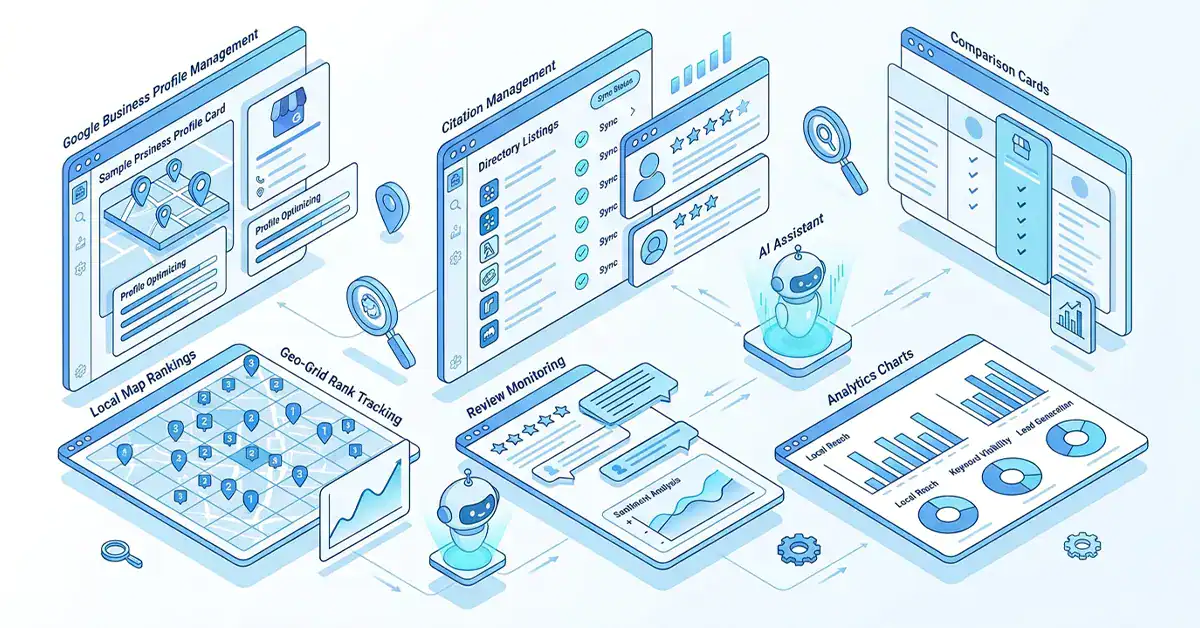
If you own a local business — or manage marketing for one — you already know the problem: you can’t show up in Google Maps or the local pack if your listings are inconsistent, your reviews are thin, and nobody is tracking your rankings.
Local SEO software exists to fix that. But the market is crowded, the pricing pages are confusing, and most “best of” lists online are thinly disguised sales pitches.
This guide is different. It’s built for small business owners, local service providers, marketing agencies, and freelancers who need a tool that actually improves visibility — not another subscription that collects dust.
We’ll walk through what these tools do, how to evaluate them, and which ones are worth your money based on your specific situation. No hype. No invented statistics. Just a clear framework and honest comparisons.
This guide is for you if you:
- Run one location or a handful of locations and want more calls, clicks, and foot traffic from local search
- Manage local SEO for clients and need reporting that doesn’t take all day to build
- Are comparing platforms and want to know what you’re actually paying for
- Have been burned by a tool that promised the world and delivered a dashboard
👉 Compare Top-Rated Local SEO Tools →
Quick Recommendation: Best Local SEO Software at a Glance
If you only read one section, read this one.
| Software | Best For | Starting Price | Pros | Rating | CTA |
|---|---|---|---|---|---|
| BrightLocal | All-in-one local SEO (audits, citations, reviews, rank tracking) | ~$39/month | Strong reporting, white-label options, broad feature set | 4.6/5 | Start Free Trial → |
| Semrush Local | Businesses already using Semrush for organic SEO | Add-on to Semrush plans (from ~$139/month) | Combines local + organic + AI search visibility | 4.5/5 | See Current Pricing → |
| Moz Local | Simple citation management on a budget | ~$14–39/month | Easy to use, solid citation cleanup, beginner-friendly | 4.3/5 | View Features → |
| Whitespark | Citation building and local ranking research | ~$33–149/month (modular) | Deep citation database, flexible à la carte pricing | 4.5/5 | Check Latest Offer → |
| Local Falcon | Geo-grid rank tracking (seeing rankings by neighborhood) | Credit-based, free credits to start | Visual map-pack tracking, useful for competitive areas | 4.4/5 | Get Started → |
| Yext | Multi-location brands and franchises | Custom / enterprise pricing | Automated sync across 200+ directories, enterprise scale | 4.2/5 | Compare Plans → |
Note: Pricing and plan structures change frequently. Always confirm current rates on the provider’s official pricing page before purchasing.
Why You Can Trust This Guide
This comparison is built on publicly available product information, documented pricing pages, verified feature lists, and independent reporting from marketing and SEO publications.
We did not fabricate user reviews, invent statistics, or claim hands-on testing we didn’t perform. Where a claim about pricing or features could change over time — which is common in SaaS — we’ve flagged that you should verify it directly with the vendor.
Our evaluation process focused on:
- Documented feature sets as published by each vendor
- Publicly listed pricing at the time of writing
- Independent commentary from SEO practitioners and industry publications
- Practical fit for different business sizes: solo operators, small teams, and agencies
We update comparisons like this periodically because SaaS pricing and features shift often. If something looks outdated by the time you’re reading this, check the vendor’s site — we link out for that reason.
How We Chose These Tools
Not every “local SEO tool” deserves a spot on a list like this. We evaluated each platform against nine criteria:
- Ease of use — Can a non-technical business owner actually operate it?
- Core features — Citation management, rank tracking, review monitoring, GBP optimization
- Reporting — Is reporting clear enough to share with a client or a boss?
- Local SEO depth — Does it go beyond generic SEO and address map-pack and “near me” visibility specifically?
- Pricing transparency — Are costs easy to understand, or is pricing deliberately vague?
- Customer support — Live chat, documentation, onboarding help
- AI search features — Does it track visibility in AI Overviews, ChatGPT, and similar AI-driven search surfaces, which increasingly influence local discovery?
- Integrations — CRM, Google Business Profile, review platforms, analytics
- Value for money — Does the price match what a business at that scale actually needs?
Tools that failed on transparency or relied heavily on locked-in annual contracts without clear value were excluded or flagged with caution.
Detailed Reviews
1. BrightLocal — Best Overall for Most Local Businesses
Overview
BrightLocal is one of the most established all-in-one local SEO platforms. It bundles rank tracking, citation building and cleanup, review monitoring, and audit tools into a single dashboard, with reporting features designed for both business owners and agencies managing multiple clients.
Key Features
- Local rank tracking across Google Maps and organic search
- Citation building and NAP (name, address, phone) consistency audits
- Review monitoring and response management across major platforms
- White-label client reports
- Local SEO audit tool that flags Google Business Profile issues
Pros
- Comprehensive feature set that covers most local SEO needs in one place
- Strong reputation in the industry with a long track record
- Reporting is genuinely useful for agencies presenting to clients
Cons
- Learning curve for users new to local SEO
- Pricing tiers can get expensive once you add citation building and multiple locations
- Some features overlap with cheaper standalone tools
Pricing
Plans generally start around $39/month for basic rank tracking and audits, with higher tiers adding citation sync and review management. Citation building is often billed separately on a pay-as-you-go basis. Confirm current tiers on BrightLocal’s pricing page, as plan names and costs are updated periodically.
Who Should Buy It
Agencies managing multiple client accounts, and single-location businesses that want one platform instead of stitching together three or four tools.
Who Should Avoid It
Solo business owners on a tight budget who only need basic citation cleanup — a simpler, cheaper tool will do the job without the extra features you won’t use.
Final Verdict
BrightLocal remains a dependable, well-rounded choice when local SEO is central to your revenue and you want a single subscription instead of a fragmented toolkit.
👉 Start Free Trial →
2. Semrush Local — Best for Businesses Already Using Semrush
Overview
Semrush is best known as a general SEO and content marketing platform, but its Local toolkit has matured into a credible local SEO offering — particularly for businesses that already rely on Semrush for keyword research, site audits, or competitor analysis.
Key Features
- Listing management across major directories
- Local rank tracking at the neighborhood level
- AI visibility tracking across AI Overviews and AI chat assistants — an increasingly important signal as more local searches happen through AI-driven interfaces
- Integration with Semrush’s broader organic SEO and content tools
Pros
- One platform for organic SEO, local SEO, and AI search visibility
- Strong data infrastructure backing the local features
- Useful if you already pay for a Semrush subscription
Cons
- Local features function as an add-on rather than a purpose-built local tool
- Pricing gets complicated once you stack multiple toolkits
- Steeper learning curve for users who don’t already know the Semrush interface
Pricing
Semrush’s core subscriptions typically start around $139/month, with the Local toolkit as an add-on priced separately (often in the $20–30/month per-location range for listing management). Always check Semrush’s current plan structure, since bundling changes over time.
Who Should Buy It
Businesses and agencies already using Semrush for organic SEO who want local visibility without adding a completely separate platform.
Who Should Avoid It
Anyone who only needs citation building and Google Business Profile management — a dedicated local tool will be cheaper and more focused.
Final Verdict
Semrush Local makes the most sense as part of a broader Semrush workflow, not as a standalone local SEO purchase.
3. Moz Local — Best Budget Option
Overview
Moz Local focuses on one job and does it well: getting your business listing accurately distributed across major data aggregators and directories, with automated duplicate listing cleanup.
Key Features
- Automated distribution to core directories and data aggregators
- Duplicate listing detection and removal
- Basic review monitoring
- Simple, beginner-friendly dashboard
Pros
- Straightforward interface, minimal learning curve
- Budget-friendly compared to full-suite platforms
- Reliable core citation management
Cons
- Lacks advanced rank tracking compared to BrightLocal or Local Falcon
- Review management tools are basic
- Not built for agencies managing large client rosters
Pricing
Historically priced in the $14–39/month range depending on plan and billing cycle (some plans are billed annually, e.g., around $129/year for a single business). Confirm current pricing directly with Moz, as tiers shift.
Who Should Buy It
Single-location businesses that are new to local SEO and want citation consistency without a complicated platform.
Who Should Avoid It
Agencies or multi-location brands that need deep rank tracking and detailed client reporting.
Final Verdict
Moz Local is a solid entry point — not the most powerful tool on this list, but a sensible low-cost starting point.
👉 View Features →
4. Whitespark — Best for Citation Building
Overview
Whitespark built its reputation on citation research and manual citation-building services, and it still publishes some of the most detailed local search ranking research in the industry.
Key Features
- Local Citation Finder that scans for citation opportunities beyond the standard directory list
- Manual citation-building services (not just automated submission)
- Local rank tracking
- Modular, à la carte pricing structure
Pros
- Genuinely thorough citation discovery, including niche and competitor-specific sources
- Flexible pricing — pay only for the modules you need
- Strong reputation among SEO professionals for research quality
Cons
- Modular pricing means costs can add up if you need multiple features
- Interface is more utilitarian than polished
- Best suited to users who already understand local SEO fundamentals
Pricing
Citation Finder plans generally range from around $33 to $149/month depending on search volume and features selected. Because pricing is modular, your total cost depends on which tools you combine.
Who Should Buy It
Businesses and agencies that see citation inconsistency as their primary local SEO problem and want a specialist tool rather than a generalist suite.
Who Should Avoid It
Anyone wanting an all-in-one dashboard with reviews, reporting, and rank tracking bundled together — Whitespark is more focused than that.
Final Verdict
If citations are your bottleneck, Whitespark is one of the most credible specialist options available.
5. Local Falcon — Best for Visual Rank Tracking
Overview
Local Falcon specializes in geo-grid rank tracking — showing exactly how your Google Maps ranking varies across different points in your service area, rather than a single average position.
Key Features
- Geo-grid visualization of map-pack rankings
- AI visibility monitoring alongside traditional rank data
- Credit-based system so you only pay for the searches you run
- Useful for diagnosing why rankings differ between neighborhoods
Pros
- Visual, easy-to-understand geo-grid maps
- Credit-based pricing can be cost-effective for occasional use
- Excellent for competitive urban markets where rankings vary block by block
Cons
- Narrower focus than full-suite platforms — it doesn’t handle citations or reviews
- Credit-based pricing can become unpredictable at scale
- Best used alongside another tool, not as a standalone platform
Pricing
Local Falcon uses a credit-based pricing model, with a batch of free credits typically offered to new users before paid credit packages are needed.
Who Should Buy It
Businesses in competitive local markets that need to understand geographic ranking variation, and agencies diagnosing map-pack visibility issues.
Who Should Avoid It
Businesses wanting one tool to handle citations, reviews, and rank tracking together.
Final Verdict
Local Falcon does one thing extremely well. Pair it with a citation tool for a complete picture.
👉 Get Started →
6. Yext — Best for Multi-Location Brands and Franchises
Overview
Yext is built for scale. It automates listing accuracy across 200+ directories, apps, and platforms simultaneously — a job that’s nearly impossible to manage manually once you’re operating more than a handful of locations.
Key Features
- Automated, real-time listing sync across a large network of directories and platforms
- Enterprise-grade knowledge management
- API access for custom integrations
- Centralized management for dozens or hundreds of locations
Pros
- Purpose-built for scale — genuinely difficult to replicate manually
- Strong for brand consistency across large location networks
- Real-time updates reduce the lag common with manual submissions
Cons
- Enterprise pricing puts it out of reach for small, single-location businesses
- Requires more setup and account management than smaller tools
- Overkill if you only manage one or two locations
Pricing
Yext uses custom, quote-based enterprise pricing tied to the number of locations and features required. Contact Yext directly for a quote based on your specific needs.
Who Should Buy It
Franchises, multi-location brands, and enterprises where manual listing management isn’t feasible.
Who Should Avoid It
Solo business owners or small teams — the cost and complexity aren’t justified at that scale.
Final Verdict
Yext earns its enterprise price tag when you’re managing listings at real scale. It’s the wrong tool for a single storefront.
👉 Compare Plans →
Full Comparison Table
| Feature | BrightLocal | Semrush Local | Moz Local | Whitespark | Local Falcon | Yext |
|---|---|---|---|---|---|---|
| Rank tracking | ✅ | ✅ | Limited | ✅ | ✅ (geo-grid) | Limited |
| Citation building | ✅ | ✅ | ✅ | ✅ (specialist) | ❌ | ✅ |
| Review management | ✅ | Limited | Basic | ❌ | ❌ | ✅ |
| White-label reporting | ✅ | ✅ | ❌ | Limited | Limited | ✅ |
| AI search visibility | Limited | ✅ | ❌ | ❌ | ✅ | Limited |
| Best for | All-in-one / agencies | Semrush users | Budget/beginners | Citation specialists | Geo-grid tracking | Multi-location brands |
| Starting price | ~$39/mo | Add-on, from ~$139/mo | ~$14–39/mo | ~$33–149/mo | Credit-based | Custom quote |
Buying Guide: How to Choose the Right Local SEO Software
How to Choose
Start with your biggest bottleneck, not the longest feature list. If your Google Business Profile listing has duplicates or inconsistent information across the web, prioritize citation tools. If you don’t know where you rank, prioritize rank tracking. If you’re managing dozens of locations, prioritize automation and scale.
Common Mistakes
- Buying an enterprise tool for a single location. Yext-level automation is wasted on one storefront.
- Running multiple rank trackers at once. Having data from five tools doesn’t make it more accurate — it just adds noise and cost.
- Ignoring reviews as a ranking and conversion factor. Review volume and recency influence both rankings and customer trust.
- Expecting overnight results. Citation corrections typically take four to eight weeks to show impact, and full ranking improvements often take twelve to sixteen weeks. Any tool or agency promising instant map-pack rankings is overselling.
- Ignoring AI search visibility. A growing share of local discovery now happens through AI Overviews and AI chat assistants, not just traditional search results.
Features to Prioritize
- Accurate, easy citation management
- Rank tracking that reflects real customer search behavior (geo-grid, not just one average position)
- Review monitoring and response tools
- Reporting you can actually share with a client, boss, or partner
- Transparent, predictable pricing
Budget Recommendations
| Business Size | Recommended Budget | Fits |
|---|---|---|
| Single location | $15–60/month | Moz Local, BrightLocal Track plan |
| Small agency (5–15 clients) | $200–500/month | BrightLocal, Whitespark modular plans |
| Multi-location franchise | Custom/enterprise | Yext, Semrush Local at scale |
Frequently Asked Questions
1. What is local SEO software, and do I actually need it? Local SEO software helps businesses manage their Google Business Profile, build accurate citations across directories, track local rankings, and monitor reviews. If your business depends on nearby customers finding you online, this software saves significant manual work and reduces costly listing errors.
2. What’s the difference between local SEO and regular SEO? Regular SEO focuses on ranking for keywords broadly, often nationally or globally. Local SEO focuses specifically on visibility in map results, “near me” searches, and location-based queries — it depends heavily on citation consistency, Google Business Profile optimization, and reviews.
3. How much does local SEO software cost? Entry-level tools start around $15–40/month for a single location. Full-featured platforms for agencies typically run $200–500/month. Enterprise multi-location tools like Yext use custom, quote-based pricing.
4. Can I do local SEO without paid software? Yes, to a degree. Google Business Profile itself is free, and manual citation submission is possible. However, tools save substantial time by automating tracking, cleanup, and reporting — especially once you manage more than one location.
5. How long does it take to see results from local SEO? Citation corrections often show impact within four to eight weeks. Broader ranking improvements typically take twelve to sixteen weeks. Local SEO is a long-term, consistency-driven effort rather than a quick fix.
6. Is BrightLocal better than Semrush for local SEO? BrightLocal is generally the stronger dedicated local SEO tool. Semrush Local makes more sense if you already use Semrush for organic SEO and want local features bundled into the same platform.
7. What is geo-grid rank tracking, and why does it matter? Geo-grid tracking shows how your ranking varies across different points in your service area rather than a single average position. This matters because map-pack rankings can differ significantly block by block, especially in competitive urban markets.
8. Do I need a tool for AI search visibility? Increasingly, yes. As more local searches happen through AI Overviews and AI assistants, tracking how your business appears in those results is becoming as important as traditional rank tracking.
9. What’s the biggest local SEO mistake small businesses make? Inconsistent business information (name, address, phone number) across directories. This confuses both search engines and customers, and it’s one of the most common — and most fixable — local SEO problems.
10. Should agencies use a different tool than single-location businesses? Generally yes. Agencies benefit from white-label reporting and multi-client management features that a single-location business doesn’t need and shouldn’t pay for.
11. Can I switch local SEO tools later without losing progress? Yes. Your rankings and citations exist independently of the software — the tool just tracks and manages them. Switching tools means re-setting up tracking and citation management, but it doesn’t reset your actual search visibility.
12. What should I check before buying any local SEO software? Confirm current pricing directly on the vendor’s site, check whether reporting fits your needs (client-facing vs. internal use), and make sure the tool addresses your specific bottleneck rather than buying based on feature count alone.
Final Recommendation
- Best Overall: BrightLocal — the most complete, dependable all-in-one platform for most local businesses and agencies.
- Best Budget: Moz Local — simple, affordable citation management for businesses just getting started.
- Best for Agencies: BrightLocal or Whitespark — strong reporting and modular options for managing multiple clients.
- Best for Local Businesses (Single Location): Moz Local or BrightLocal’s entry-level plan.
- Best for Multi-Location Brands: Yext — built specifically for scale.
- Best AI Search Tool: Semrush Local — the most developed AI visibility tracking on this list.
There’s no single “best” tool for everyone. The right choice depends on how many locations you manage, your budget, and whether citations, rankings, or reviews are your biggest gap right now.
Ready to Improve Your Local Rankings?
Local SEO rewards consistency, not guesswork. Whether you’re managing one storefront or fifty, the right software turns hours of manual directory checking and spreadsheet tracking into a system you can actually maintain.
Start by identifying your single biggest local SEO gap — citations, rankings, or reviews — and choose the tool built to solve that problem first. You can always add more capability later as your needs grow.
👉 Compare Top-Rated Local SEO Tools and Find Your Fit →